The Authority Audit
Four questions. Eight points. Ninety seconds.
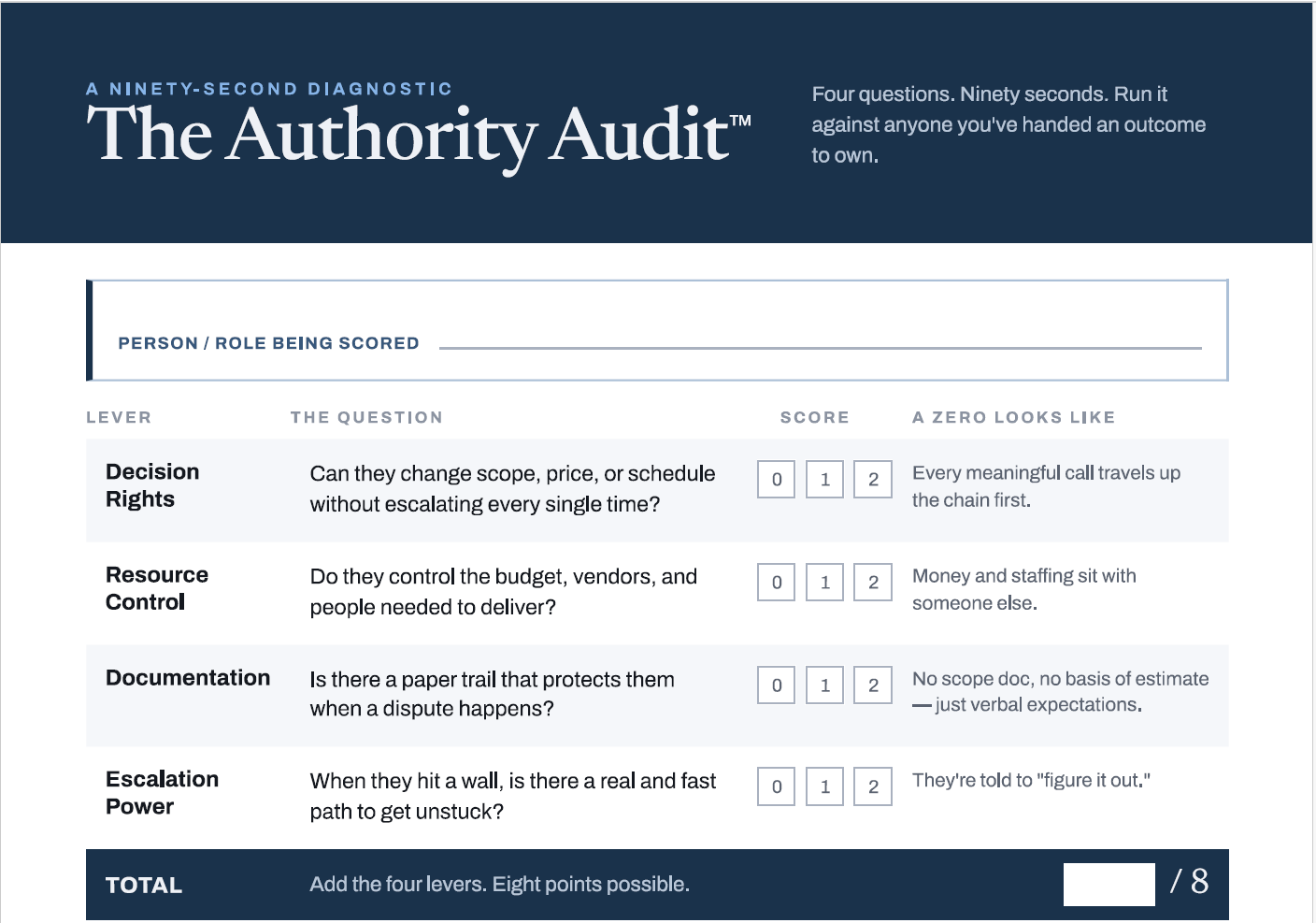
Run it on any person you have handed a meaningful outcome to own - a project, a target, a turnaround, a deadline they’re accountable for. Score each level zero, one or two. Zero means none, one means partial, two means full.
LEVER 1 - DECISION RIGHTS: Can this person change scope, price or schedule without escalating every single time? Not “can they escalate.” Everybody can escalate. The question is whether than can decide.
Score zero when every meaningful call has to travel up the chain before anything moves. On the ground it looks like a project manager who needs approval to move a deadline three days, or a manager who owns a budget number but can’t authorize a purchase against it.
LEVER 2- RESOURCE CONTROL: Do they control the budget, the vendors and the people they need to actually deliver?
Score zero when the money and the staffing sit with someone else who has their own priorities. if you have ever heard someone say “I’m responsible for this but I have to beg for the resources” you have heard a Resource Control zero.
LEVER 3- DOCUMENTATION: Is there a paper trail that protects this person when a dispute happens?
This is the one people skip. Score zero when expectations are verbal, scope is fuzzy, and there’s no document anyone can point to when two parties remember the agreement differently.
LEVER 4- ESCALATION POWER: When they hit a wall, is there a real and fast path to get unstuck?
Both words matter. A path that exists on paper but takes six weeks is not escalation power. A path that ends with someone saying “figure it out” is not escalation power.
6 - 8: REAL AUTHORITY
This person can do the job you’ve given them. Support them and get out of the way.
3 - 5: PARTIAL AUTHORITY
The dangerous middle, and where most people in most organizations actually live. They can do enough of the job to look like it’s working - right up until it isn’t. This is where good people quietly burn out and leaders are genuinely surprised when they do.
0 - 2: RESPONSIBILITY TRAP
Fix it before you assign it, or don’t assign it at all. There is no amount of talent, effort or commitment that closes a gap this size.
Print it. run it in a staff meeting. Run it on yourself.
The download includes the four levers, the scoring brands, the three questions to ask before assigning an outcome, and the distinction between an individual authority gap - which you can fix - and a structural one, which requires creating a role that doesn’t exist yet.
Get the one-page scorecard.
In Afghanistan, when a convoy needed to make a left-hand turn, the lead vehicle pulled out and blocked oncoming traffic - holding it, exposed, on a road whith a known IED threat - until every vehicle behind it had made the turn. Nobody radioed for permission. Nobody had to be told.
Decision Rights: the driver could change route, speed and direction oh their own judgement. Two.
Resource Control: everything that convoy needed was already in it. Two.
Documentation: doctrine. Everyone in every vehicle knew what a left-hand turn meant before it happened. Two
Escalation power: radio, immediate, with someone on the other end whose job was to answer. Two.
Eight out of eight. Not comfortable. Not safe. That convoy was in danger every time it rolled.
But every person could act.